
The Carbon-Circular Nexus
As the global industrial sector navigates the midpoint of this decisive decade, the limitations of a purely energy-centric decarbonization strategy have become apparent. While the transition to renewable electrification and green hydrogen is non-negotiable, these solutions primarily target energy-related emissions. In “hard-to-abate” sectors—steel, cement, chemicals, and aluminum—nearly half of the total greenhouse gas (GHG) footprint stems from “process emissions” and the inherent inefficiency of linear material flows.
According to 2026 climate benchmarks, while energy transition can address approximately 55% of global emissions, the remaining 45% are structurally tied to the way we produce and manage materials. This is where the Circular Economy emerges as the “silent engine” of decarbonization. By decoupling economic growth from virgin resource extraction, circularity provides a systemic lever to collapse the carbon intensity of heavy industry.
The Shift from “Linear-Waste” to “Circular-Carbon”
The traditional “take-make-waste” model is being replaced by Circular Materials Management. This transition goes far beyond the limited scope of traditional recycling. It represents a fundamental redesign of industrial chemistry and metallurgy.
One of the most transformative shifts in 2026 is the conceptualization of “Carbon as a Feedstock.” Rather than treating $CO_2$ as an atmospheric waste product to be buried via Carbon Capture and Storage (CCS), advanced industrial clusters are pivoting toward Carbon Capture and Utilization (CCU). Here, captured emissions are redirected as essential inputs for synthetic fuels, carbon-fiber composites, and chemical building blocks. We are moving from an era of carbon disposal to an era of carbon circulation.
Sector-Specific Decarbonization Levers
1. Steel: The Scrap-to-EAF Revolution
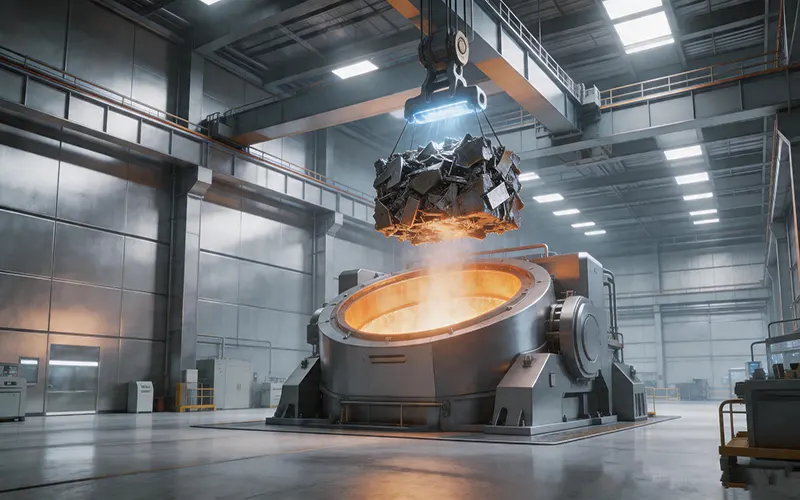
Steel production is undergoing a massive shift from carbon-intensive Blast Furnace/Basic Oxygen Furnace (BF-BOF) routes to Electric Arc Furnaces (EAF). The circular lever here is the maximization of high-quality scrap metal circulation. Utilizing recycled steel reduces the energy intensity of production by approximately 75% compared to ore-based primary production. However, the 2026 challenge lies in “copper contamination” and metallurgy purity; thus, the industry is investing heavily in robotic sorting to ensure that secondary steel meets the high-performance specifications of the automotive and aerospace sectors.
2. Cement: Industrial Symbiosis and Clinker Substitution
In the cement sector, the primary hurdle is the calcination of limestone, which releases $CO_2$ as an inherent chemical byproduct. Circularity addresses this through Industrial Symbiosis. By integrating waste streams from other industries—such as granulated blast furnace slag from steel mills or fly ash from power generation—as clinker substitutes, cement plants are significantly reducing their thermal and chemical emission profiles.
3. Chemicals: Plastic-to-Plastic Chemical Recycling
The chemical industry is pivoting from fossil-based feedstocks to circular carbon. Chemical recycling (pyrolysis and gasification) now allows complex plastic waste, previously destined for landfills, to be broken down into their original molecular monomers. This creates a closed-loop system where a plastic bottle can theoretically become a high-purity medical device, bypassing the need for new naphtha extraction.
Industrial Symbiosis 2.0: The Rise of Industrial Clusters
The 2026 landscape is defined by the emergence of Integrated Industrial Clusters. In these ecosystems, the “waste” of one facility is the “wealth” of another. A prime example is the synergy between steel and cement: the excess heat from an EAF can provide the thermal energy for a nearby chemical refinery, while the slag byproduct is piped directly to a cement kiln.
This systemic integration minimizes the total emission footprint of the cluster ($E_{total}$), which can be calculated as:
$$E_{total} = \sum_{i=1}^{n} (M_i \times EF_i) – R_{circular}$$
Where $M_i$ is the mass of material, $EF_i$ is the emission factor, and $R_{circular}$ represents the avoided emissions through resource recovery and shared energy loops.
The Role of Technology & AI: Digital Product Passports
True circularity requires radical transparency. In 2026, the implementation of Digital Product Passports (DPPs) has become a mandatory standard in many jurisdictions. Enabled by AI-driven material tracking and blockchain-verified supply chains, DPPs provide a high-fidelity record of a material’s chemistry, origin, and recycling potential. AI algorithms now allow for the automated disassembly of complex industrial goods, ensuring that rare earth metals and high-purity alloys are recovered at the end of their lifecycle with minimal degradation.
Economic and Regulatory Drivers
The economic logic of circularity is being codified by regulation. The EU’s Carbon Border Adjustment Mechanism (CBAM) and similar global frameworks have leveled the playing field, making carbon-intensive primary materials more expensive than their circular counterparts. Furthermore, Green Public Procurement standards now mandate that large-scale infrastructure projects (bridges, highways, and skyscrapers) must utilize a minimum percentage of circular steel and low-carbon cement, effectively de-risking the massive CapEx investments required for circular transitions.
Comparison: Primary vs. Secondary (Circular) Production
| Material Sector | Energy Intensity (Primary) | Energy Intensity (Secondary) | CO2 Reduction Potential |
| Steel | ~20 GJ/t | ~5 GJ/t | 75% |
| Aluminum | ~170 GJ/t | ~10 GJ/t | 90% – 95% |
| Plastics | High (Fossil) | Moderate (Chemical) | 50% – 70% |
| Cement | ~3.5 GJ/t | ~2.0 GJ/t (Symbiosis) | 30% – 40% |
The Four Pillars of Circular Decarbonization
- Material Efficiency: Using less material by design and extending product lifespans through modularity.
- Secondary Production: Shifting from virgin ore/feedstocks to recycled and recovered materials.
- Waste-to-Resource Transformation: Turning $CO_2$ and industrial by-products into high-value feedstocks.
- Collaborative Ecosystems: Moving from isolated plant operations to integrated industrial symbiosis hubs.
Resource Sovereignty as the New Competitiveness
The transition to a circular economy in heavy industry is no longer just a “sustainability” initiative; it is a strategic imperative for Resource Sovereignty. In a world of volatile commodity prices and geopolitical uncertainty, the ability to recover and circulate critical minerals and materials within domestic borders provides a significant competitive advantage.
Circular decarbonization is the only viable path to a net-zero industrial base. By closing the loops on carbon and materials, heavy industry can finally break the historical link between industrial prosperity and environmental degradation. The leaders of 2026 are those who view their facilities not as isolated producers of goods, but as vital nodes in a global, circular, and carbon-neutral network.