Redefining the “Side Hustle” for Executives
For the modern corporate executive—earning $200k+ and navigating the complexities of V-suite or Director-level roles—the concept of a “side hustle” often feels beneath their skill set. They don’t need a second job; they need an asset. In 2026, wealth diversification has moved beyond the stock market and real estate into Semi-Absentee Franchise Ownership.
A semi-absentee franchise is a “manager-run” business model designed specifically for the individual who wants to work on the business, not in it. Under this framework, the owner typically dedicates 10 to 15 hours per week to high-level strategy, financial oversight, and growth scaling, while a professional unit manager handles the day-to-day operational “firefighting.” It is the ultimate vehicle for achieving “Plan B” career security while maintaining a high-powered primary career.
The “Corporate Synergy” Argument
Why do corporate professionals excel in this space? Because the skill sets required to lead a department or a region are identical to those required to oversee a multi-unit franchise empire. As an executive, you are already an expert in:
- KPI Management: You know how to read a P&L and identify “red flags” in labor costs or COGS.
- Leadership Development: You understand how to motivate a manager and build a culture of accountability.
- Systems Thinking: You value the “playbook”—the standard operating procedures that make a franchise scalable.
In the corporate world, you use these skills to build someone else’s equity. In a semi-absentee franchise, you use them to build your own.
Top Semi-Absentee Industry Sectors for 2026
1. Health & Wellness (Boutique Fitness and Pilates)
Fitness models, particularly those based on recurring memberships, are highly compatible with semi-absentee ownership. Once the initial membership base is established, the revenue becomes predictable. High-end Pilates and boutique yoga studios often attract a professional clientele, ensuring a stable and respectful environment for your management team.
2. Automotive Services (Quick-Lube and Car Washes)
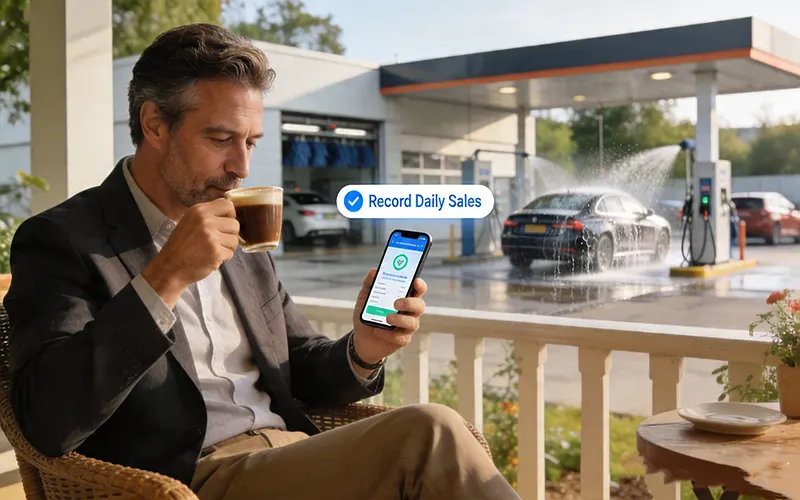
Automotive franchises are “lean staffing” models. An oil change or car wash facility can often run with just 2–4 employees per shift. Because the service is standardized and highly automated, there is less “creativity” required from the staff, making it easier to monitor performance remotely through data analytics.
3. Beauty & Personal Care (Hair Salons and Medspas)
Beauty services are historically resilient to e-commerce disruption. You cannot “download” a haircut or a Botox treatment. Medspas, in particular, offer high average ticket prices and strong margins, allowing for the higher salaries required to attract top-tier managers.
4. Automated Retail and High-End Vending
The “unmanned” revolution of 2026 has made high-end vending (specialty coffee, healthy meals, or electronics) a premier semi-absentee play. With near-zero labor costs, the owner’s role is almost entirely focused on supply chain logistics and site acquisition.
Operational Infrastructure: The “Strong Unit Manager”
The lynchpin of the semi-absentee model is the Unit Manager. To succeed, you must hire for the “Owner’s Mindset.” This is not a role for a junior employee; it is a role for a “general manager” who is incentivized through profit-sharing or performance bonuses.
The most successful executive owners treat their manager as a partner. They provide the manager with the autonomy to lead but maintain a rigorous weekly “KPI Review” to ensure the business is hitting its targets. If you can’t trust your manager to open the doors, you don’t have a semi-absentee business—you have a time-consuming hobby.
Technology as the “Remote Boss”
Managing a business in 10 hours a week is only possible through the sophisticated tech stacks available in 2026. Executive owners now utilize:
- AI-Driven Scheduling: Optimizing labor costs in real-time based on historical traffic patterns.
- Remote Visual Auditing: High-definition CCTV integrated with AI that flags operational anomalies (e.g., long wait times or safety violations).
- Cloud-Based Dashboards: P&L data that syncs directly from the POS to your phone, allowing for “management by exception”—you only step in when the numbers deviate from the norm.
The Financial Reality: The Time-Wealth Trade-off
Transparency is vital: a semi-absentee model usually requires a higher initial capital investment than an owner-operator model. Because you are hiring a professional manager from Day 1, your “break-even” point will be further out. You are trading initial cash flow for time freedom.
| Feature | Owner-Operator | Semi-Absentee (Executive) |
| Weekly Time Commitment | 40 – 60+ Hours | 10 – 15 Hours |
| Initial Investment | Lower (Owner is the labor) | Higher (Manager salary is built-in) |
| Risk Profile | High (Business stops if you stop) | Diversified (Managed by systems) |
| Scalability | Limited by owner’s time | Highly Scalable (Multi-unit focus) |
Due Diligence: What to Look for in the FDD
When an executive reviews a Franchise Disclosure Document (FDD), they should look beyond the branding and focus on Validation.
- Item 19: Does it show high enough margins to support a $60k–$80k manager salary?
- Existing Owners: When you call existing franchisees, ask: “How many hours do you actually spend on this? Is the franchisor supportive of the manager-run model, or do they push for owner-operators?”
- The “5 Signs” Checklist:
- A simplified service offering (no complex “from-scratch” cooking).
- Sophisticated POS and back-office reporting.
- Strong national brand awareness to drive organic traffic.
- A proven “Manager Training Program” provided by the franchisor.
- A labor model that doesn’t require “highly specialized” (hard to replace) talent.
Achieving True Ownership
The goal of the semi-absentee model is to move from being an “employee of your own business” to being a “true owner.” For the corporate professional, this is the bridge to financial independence. It allows you to build a resilient, cash-flowing asset while still climbing the corporate ladder. Eventually, when the franchise cash flow matches your executive salary, you are no longer working because you have to, but because you choose to. That is the ultimate ROI.